
Train Automation: Automatic Train Operation

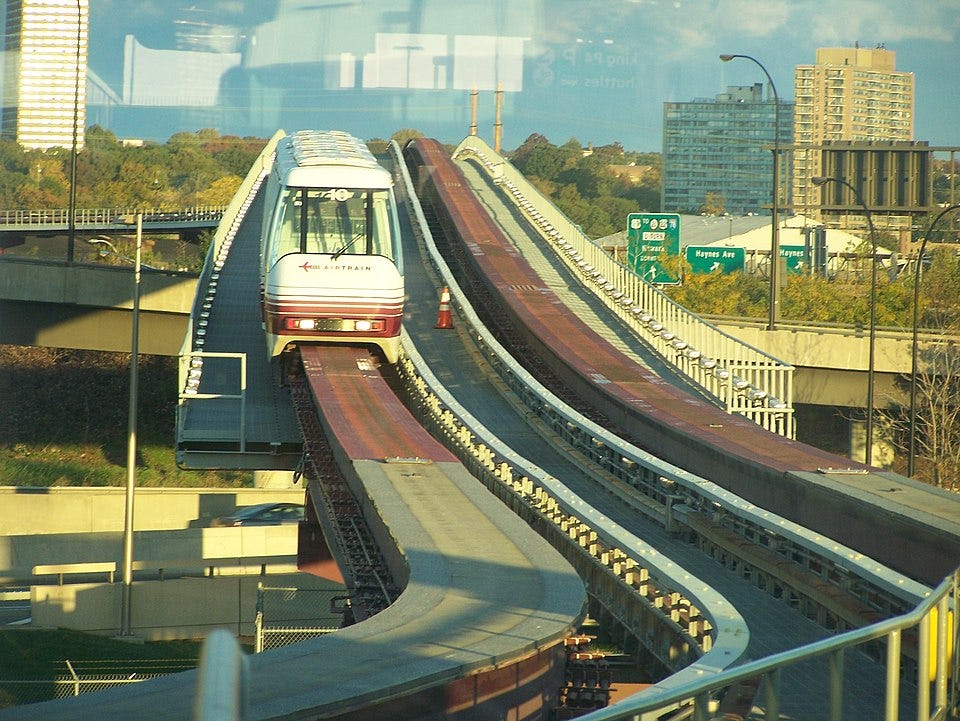
So, I touched upon automatic train operation (ATO) in a previous post. What it had to do with is the Montreal Réseau express métropolitain (REM) line in Montreal, Quebec, Canada. (See: “Commentary: Who’s Minding The Train?” here: https://allabouttrains.substack.com/p/commentary-whos-minding-the-train).
What I want to do now is explore ATO further.
I would like to start off by saying that automatic train operation isn’t any real mystery. The main emphasis here is ATO-operated trains do not require drivers.
An oversimplification, no question. ATO can further manage other types of operations such as “programmed stopping, speed adjusting, door operation, and similar [operations that are] otherwise assigned to the train operator,” according to related information posted at Wikipedia.[1]
It is moreover explained on Wikipedia that:
The degree of automation is indicated by the Grade of Automation (GoA), up to GoA4 in which the train is automatically controlled without any staff on board….[1]
So let’s now talk about ATO’s advantages.
At least one advantage in operating trains this way is that anytime there’s the need for a capacity increase, this can be done with something as basic and simple as adding trains. The beauty of this type of approach, especially for cash-strapped systems and services, is that trains can be added to meet passenger demand without there being the need to hire additional onboard operating personnel. That’s just one of the advantages that ATO can offer.
Wikipedia lists others:
Eliminating human sources of errors
Increasing capacity by stronger utilisation of existing rail tracks
Reduction of operational costs….
Increasing overall service reliability
Improving fleet management and service flexibility
Increasing energy efficiency[1]
It’s important to keep in mind that just because an operation is, well, driverless, this is no guarantee that things still can’t — and won’t — go awry.
How many news reports have there been of situations where autonomous vehicles (AVs) have crashed? Those familiar with such mishaps know all too well. Many, I suspect, would be fast to acknowledge that as development advances, the platform is both becoming and will continue to become more and more refined, with more and more so-called “bugs” being ironed out over time.
That right there has to do with autonomous motor vehicle operation.
But what about as it has to do with such matters pertaining to automated train operations? What I was able to find was the following. It’s a “Safety Recommendation” issued by the National Transportation Safety Board on Sept. 22, 2009.
The text of the letter in part reads:
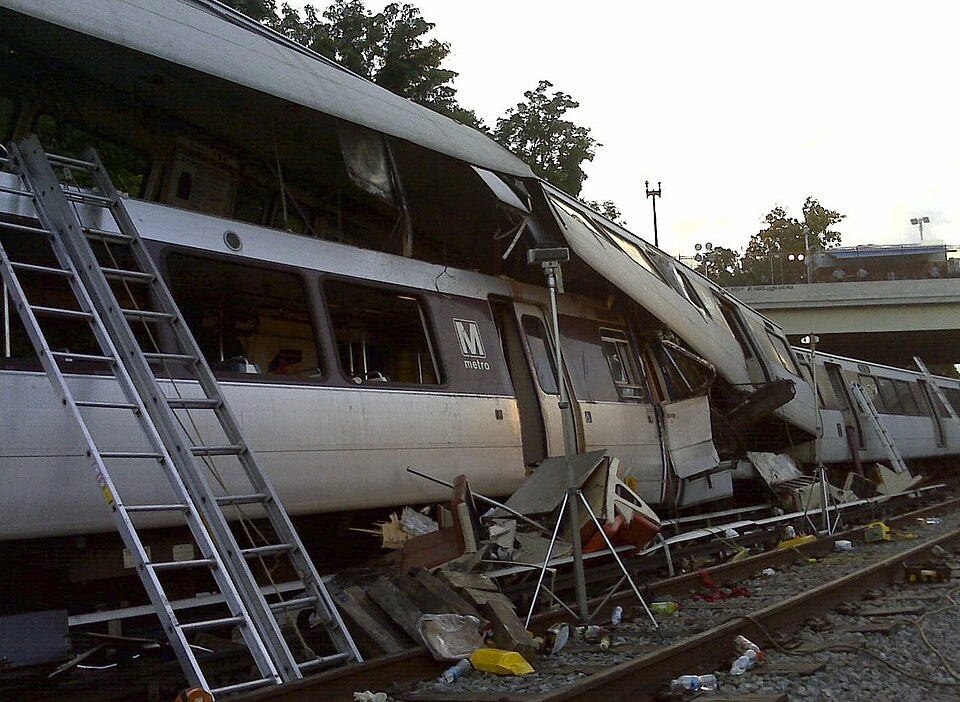
On Monday, June 22, 2009, about 4:58 p.m., eastern daylight time, southbound WMATA Metrorail train 112 was traveling in a curve when it struck the rear end of Metrorail train 214 before reaching the Fort Totten station. There was no communication between the train operators and the Metrorail Operations Control Center before the collision. During the collision, the lead car of train 112 telescoped and overrode the rear car of train 214 by about 50 feet. Examination of the track and wreckage indicated that the emergency brake on train 112 was applied before impact. The District of Columbia Fire and Emergency Medical Service reported 9 fatalities and transported 52 persons to local hospitals.
Although the investigation is ongoing, postaccident testing showed that the track circuit at the accident site lost detection of train 214 when it stopped at the location where the collision occurred. Because the automatic train protection (ATP) system was not detecting train 214’s location, the following train (train 112) did not receive a command to slow or stop in order to maintain train separation. Maximum authorized speed in the accident area is 59 miles per hour.
Train operations on all Metrorail mainline routes can be carried out in either automatic train control (ATC) or manual control by a train operator. ATC consists of three control subsystems: ATP, automatic train supervision, and automatic train operation. On the Metrorail system, ATP is designed to provide protection against collisions and overspeed conditions in both automatic and manual train operations. The system detects trains and transmits speed commands[2]
If I recall correctly, Metrorail, in the recent past, resumed automated train operations.
Notes
Wikipedia, “Automatic train operation”. Representative URL: https://en.wikipedia.org/wiki/Automatic_train_operation
National Transportation Safety Board, “Safety Recommendations” letter, Sept. 22, 2009. Representative URL: https://web.archive.org/web/20101227071840/http://wmata.com/about_metro/FTASafetyRecLtr.pdf
Related
“Drive Time: Machine Versus Human Being,” an Apr. 24, 2025 All About Trains post. Representative URL: https://allabouttrains.substack.com/p/drive-time-machine-versus-human-being
“To Automate Or Not To Automate, That Is The Question,” a Nov. 9, 2024 All About Trains post. Representative URL: https://allabouttrains.substack.com/p/commentary-to-automate-or-not-to
All material copyrighted 2026, Alan Kandel. All Rights Reserved.