
Traction: Monorails
Explainer

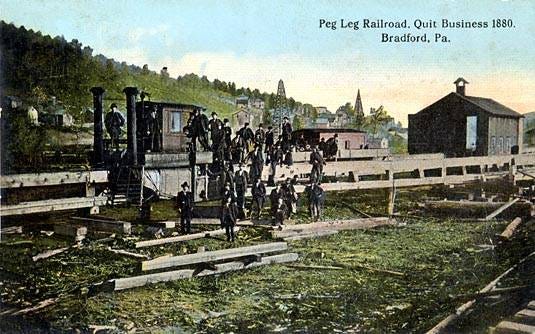
Monorails (referring to trains running on a track having but one rail and therefore their being given the term “monorail”) in the United States are all of the straddle beam variety, where the center beam or rail are “straddled” by the monorail vehicle itself and derive their traction from electric motors that drive rubber tires contacting the sides as well as tops of the track guiding beams, and all, by the way, are elevated. The other monorail types include overhead-suspended and maglev.
Monorail systems can be elevated, placed subsurface or run on ground or surface level, the last known as “at-grade running.”
So how is it that monorail trains came to exist in America?
According to information sourced from Wikipedia, “Inspired by the Centennial Monorail demonstrated in 1876, in 1877 the Bradford and Foster Brook Railway began construction of a 5 mi (8.0 km) line connecting Bradford and Foster Township, McKean County in Pennsylvania. The line operated from 1878 until 1879 delivering machinery and oil supplies. The first twin-boiler locomotive wore out quickly. It was replaced by a single boiler locomotive which was too heavy and crashed through the track on its third trip. The third locomotive again had twin boilers. On a trial run one of the boilers ran dry and exploded, killing six people. The railway was closed soon after.”*
Furthermore, “In the northern Mojave Desert, the Epsom Salts monorail was built in 1924. It ran for 28 miles from a connection on the Trona Railway, eastward to harvest epsomite deposits in the Owlshead Mountains. The Lartigue type monorail achieved gradients of up to 10 percent. It only operated until June 1926, when the mineral deposits became uneconomic, and was dismantled for scrap in the late 1930s.”*
The monorail’s main advantage seems to be in being elevated or placed in tunnels, removed is any possibility of the monorail vehicles colliding with pedestrians or motorists, or such objects as bicycles, trucks, conventional trains, etc., though the possibility of a monorail train colliding with another monorail train on the same track does exist in the absence of the installation of a working and effective onboard computer-based collision-avoidance capability or protocol.
Monorails, however, have found limited application in moving people such as at airports, in large cities and at theme parks.
In the United States, monorail systems can be found in cities such as Aiea, Hawaii; Anaheim, California; Bay Lake and Jacksonville in Florida; Las Vegas, Nevada; Newark, New Jersey; and Seattle, Washington. I’ve ridden on the one in California at Disneyland in Anaheim.
Meanwhile, the most prevalent monorail systems in the United States are sourced from ALWEG, a German company and the French corporation, Bombardier.
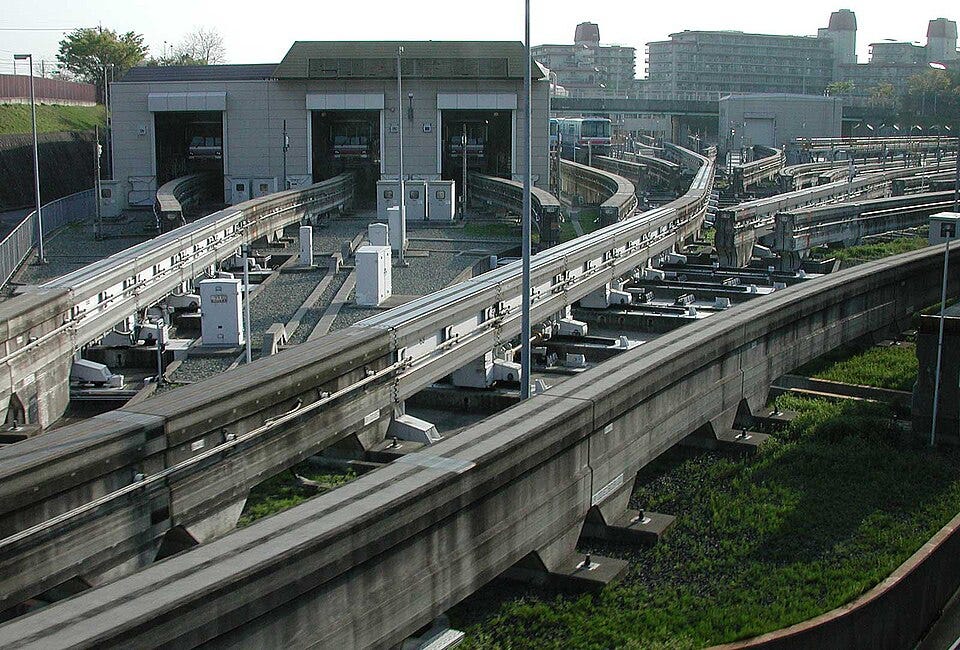
Lastly, the ability for a monorail train to switch tracks exists, and the method by which trains can switch tracks is not complicated in the least. Making said switch possible is a movable section of track which through an electro-mechanical means swivels horizontally to line up with stationary track sections that provide said switched trains different routing options. The photograph below shows several track switches at what appears to be a train storage facility.
* Wikipedia, “Monorail.” Representative URL: https://en.wikipedia.org/wiki/Monorail
Updated: Jan. 9, 2026 at 12:18 p.m. PST.
All material copyrighted 2026, Alan Kandel. All Rights Reserved.