
Commentary: Going Nowhere Fast: Maglev — It’s (So Far) Failed To Gain (Serious) Traction

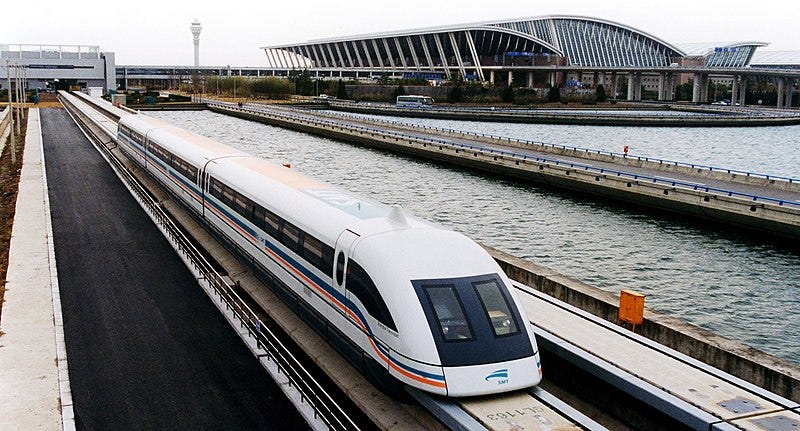
In Japan, the most recent addition in the maglev-train lineup is the Chuo Shinkansen, which has been in the works since 2014. It’s completion date, however, is anyone’s guess on account of a local government authority rejecting a construction permit.[1]
In terms of its deployment and use, maglev could one day become the preferred rail-travel method. Though it hasn’t quite gotten to that place yet.
Maglev can certainly allow for great distances to be covered in a very, very short span of time, that is, compared to a conventional train traveling on conventional track. That is perhaps the mode’s most salient attribute. But, the platform is costlier in terms of operating performance and these trains consume relatively high amounts of energy, comparatively speaking. And, that right there could be the one limiting factor that has prevented more of these systems from being deployed. A mere six maglev systems exist in the world currently. According to information at Wikipedia, China has three, South Korea two and Japan one.[2] The concept has been on the books in one form or another since 1902.[3]
There have been a number of proposals that were made public to get a maglev system built here. One was in Orlando, Florida. The plan was to have a low- or medium-speed system that would connect the convention center to the international airport there. As proposed, it would have been built on elevated infrastructure. Another proposal was premised on the notion of building the system subsurface and connecting not one, but two airports: Ontario and LAX in California. To be some 60 miles or so in length, the suggestion was eventually dropped most likely due to the expense involved to build it. Apparently, it didn’t pencil out.
Add to this the plan to have built an approximately 50-mile-long line, again subsurface, linking Washington, D.C. and Baltimore, Maryland. In response, the point was raised that because of incompatibility issues, passengers wishing to continue their journeys northward or southward past Baltimore, once arriving there, they would be required to switch mode types, like from, say, the maglev to a conventional passenger train. As far as I am aware, that proposal was scrapped.
And, finally, in regard to connecting Las Vegas (L.V.), Nevada with Los Angeles (L.A.), California with a surfaced-based railroad network, maglev was among the proposals. That was abandoned in favor of a conventional high-speed train, line and network. It is by and large being built in the median of Interstate 15 (I-15) and goes by the name Brightline West. Though it will not reach all the way into L.A. initially, the long-range plan is that it will one day. Trains will travel at a maximum speed in the 200 miles per hour range and the track will connect, at first the Silver State desert community with the Golden State’s southern California-located city of Rancho Cucamonga (R.C.). It is expected to be operational and receive passengers by year 2028, in advance of the Summer Olympic Games that year. Rail-passenger service provided to and from R.C., will be courtesy of commuter-rail operator Metrolink.
So, that leaves passive maglev.
Passive maglev has been among the solutions proposed, itself popularized by billionaire Elon Musk. His so-called Hyperloop concept, as I understand it, involved utilizing transport capsules or pods or sleds placed inside sealed tubes, the purpose of which was to facilitate a lower coefficient of friction while at the same time create improved transport-pod aerodynamics. The public was first introduced to the concept in August 2013, and almost immediately, interest skyrocketed. That interest soon morphed into focused if not intense research being conducted with development ensuing. The R&D continued apace. Hyperloop seemed all the rage, at least, for a time, anyway.
If I have this right, Musk at some point came up with the grandiose idea of building Hyperloop between L.A. and San Francisco. All well and good but at what cost and on whose land was it to be built upon?
There is documented, physical proof to show that different people at different times brought to light their own versions or schemes. Call them all variations on a basic theme. And, if you just so happen to believe it was Musk and Musk alone who conjured in his mind this, well, pipe dream if you like, my one response to that: dream on.
And was there something Musk saw in Hyperloop that others at first maybe did not? If anything, it was the potential of Hyperloop being a reasonable, less costly alternative to California’s high-speed-rail project, which, in case you don’t already know, Musk was opposed to.
Meanwhile, in 2011, I embarked on my own project, beginning work on my self-published e-book The Departure Track: Railways of Tomorrow, an impartial, semi-technical, independent study detailing three rail-based transit systems each incorporating and utilizing completely different methods of propulsion. It took me two years to get the project completed. I published the e-book on Dec. 8, 2013.
One of the systems, skyTran, made use of what is referred to as “Passive Maglev”. In Chapt. 2: Section 2.2: Up In The Sky(Tran), in the section “Not Your Parents’ Wheels” in the subsection: All Rides on Magnetic Levitation, Christopher Perkins, then skyTran Executive VP, Government Affairs explained the difference between “active” and “passive” maglev.
Here is what Perkins had to say:
“Active maglev requires external power to induce levitation. Passive maglev requires no external power to levitate vehicles. Rather, the magnetic repulsion is produced by the movement of the vehicle over shorted wire coils in the track. Essentially, a linear motor that provides vehicle locomotion does double duty by inducing the levitation effect. Passive maglev devices are low cost and simple to manufacture, very reliable, and require little maintenance.”
This is an oversimplification, obviously. But, even then, it still isn’t as simple as that.
As I wrote in a previous post, in a test that was conducted in the desert near Las Vegas, Nevada, two people rode in a sled inside an enclosed pipe propelled by a linear induction motor built on the principle of passive magnetic levitation that reached a maximum velocity, according to reports, of 107 miles per hour. The skyTran prototype was much father along in development when it was tested, but, in the end, the outcome is the same: Neither, to my knowledge, have become commercialized.
Notes
Wikipedia, Maglev, under the “History” subheading. https://en.wikipedia.org/wiki/Maglev
Ibid., Maglev, https://en.wikipedia.org/wiki/Maglev
Ibid., Maglev, under the “History” subheading. https://en.wikipedia.org/wiki/Maglev
Updated: Nov. 21, 2024 at 5:18 p.m. PST.
Image credit: Alex Needham via Wikimedia Commons
All material copyrighted 2024, Alan Kandel. All Rights Reserved.